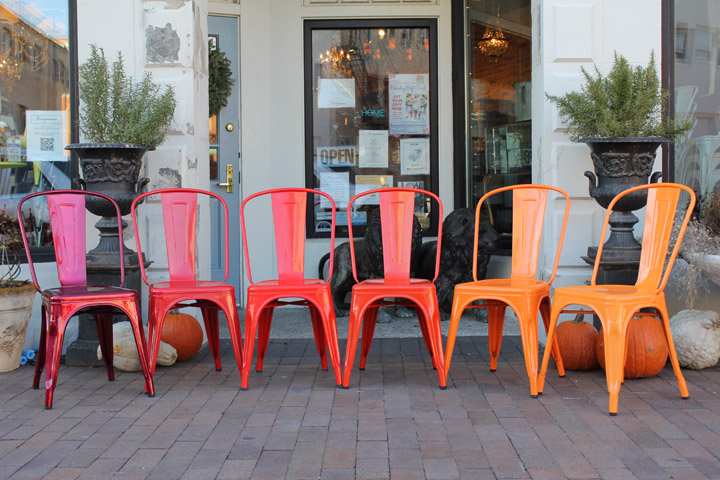
What is powder coat? As the name suggests, the paint is in powder form, which is coated on the metal surface. Some recent developement have deviced a complex process to paint on high density fibreboard better known as HDF. The process was invented by Daniel Gustin in 1940s, the main benefit of the paint is the durability it gives while making a symmetrically smooth layer. However its an industrial process and cannot be done on a small scale or n a DIY manner. The typical thing in this process is that where we are mostly familier with NC based, turpinetine based, thinner based paints; there is no solvant involved in powder paint process. It is bonded with heating.
Process:
- For powder coat to happen flawlessly the metal item is prepared by sand blasting it via cyclone process, the item is kept in a closed room in which fine sand is blasted with pneumatic nozzles at high pressure. This abrasive process removes any corrosion, oil residual, paint on the surface; also makes it smooth.

Process of sand blasting. The sand is blasted via air pressure which is created via an air compressor.
2. Then the powder which is thermoplastic or thermoset polymer (for sun friendly finish, outdoor powder coat.), which is applied by a gun which throws the charged powder on the metal, there is no solvent present,
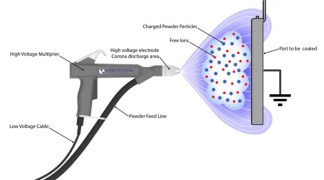

3. To bond the powder to the metal surface the piece is further cured by typically heating it to 150 to 200 degree Celsius in a closed environment to avoid any impurities to seep in the product is then cooled down to room temperature.

Typical Oven Used For Powdercoating.
This process makes a fine coat over the metal with thickness of around 30 to 80 micron. Depending on how thick the powder was initially.
Advantage of Powder Coat Paint
- It lasts longer than usual paints; duco, automative paint, oil based paints.
- High quality output in terms of smoothness, feel and look.
- For outdoor, powder coat is the best option. In outdoor furniture a variant called Pure Polyester is used.
- The coating layer of powder coat is thicker than normal other paints.
- There are no drip marks in powder coating.
- Powder coating is economical.
- Its scratch resistant.
- Since it doesn’t produce fumes, its good for environment and the people working in the unit.
Disadvantages of Powder Coat Paint
- The setup is costly, needs lot of space; and getting clearance of sand blasting is not easy.
- If the paint chips off, its not easy to do touchups.
- Once the powder coating is done, no other paint can be done on it.
- Limited color choices. For customised color large amount of quantities are needed.
FAQs
1. What is powder coating?

Powder coating is a dry finishing process where powdered paint (usually a thermoplastic or thermoset polymer) is electrostatically applied to a metal surface and then cured under heat to form a smooth, durable, and uniform coating.
2. How is powder coating different from traditional paint?
Unlike traditional liquid paints that use solvents, powder coating contains no solvents. It's applied as a dry powder and cured with heat, making it more durable and environmentally friendly.
3. Can powder coating be done at home or on a DIY basis?
No, powder coating is an industrial process that requires specialized equipment like sandblasting chambers, electrostatic spray guns, and curing ovens. It's not feasible for small-scale or home DIY use.
4. What is the process of powder coating?
The process involves:
Surface preparation via sandblasting to clean and smoothen the metal.
Application of powder using a spray gun that electrostatically charges the powder.
Curing the coated object in an oven at 150–200°C to bond the powder to the surface.
5. What materials can be powder coated?
Primarily metals are powder coated. However, newer technologies allow for powder coating on HDF (High-Density Fibreboard) as well, though it's more complex.
6. What are the advantages of powder coating?
Long-lasting and durable finish
Smooth, drip-free application
Environmentally friendly – no harmful fumes
Scratch-resistant and ideal for outdoor furniture (e.g., using Pure Polyester variant)
Thicker coating than conventional paint
Cost-effective in the long run
7. What are the disadvantages of powder coating?
High initial setup cost
Difficult to repair or touch up if chipped
Limited color choices unless ordered in bulk
No re-painting possible once the surface is powder coated
8. How thick is a typical powder-coated layer?
The final powder-coated finish usually has a thickness of 30 to 80 microns, depending on the powder used and application process.
9. Who invented powder coating?
The modern powder coating process was invented by Daniel Gustin in the 1940s.
10. Why is sandblasting necessary before powder coating?
Sandblasting removes rust, oil, old paint, and impurities from the metal surface, ensuring better adhesion of the powder and a smoother, cleaner finish.
"Connect with Us – Explore Jodhpur Furniture!"
Like this:
Like Loading...